Why Use AI Search Monitoring Tools: Brand Tracking & Success Metrics
Put this guide into practice with our free companion browser tools.
100% free, client-side private, and zero sign-up required. Run keyword clustering, schema generation, or SERP previews in seconds.
Why Use AI Search Monitoring Tools in 2026
Generative AI search engines—including Google AI Overviews, Perplexity AI, ChatGPT Search, and Claude Artifacts—are fundamentally reshaping how organic search traffic flows to websites.
In traditional search engine optimization, tracking success was linear: you tracked rank positions #1 through #10 for targeted keywords on Google. Today, AI answer engines synthesize answers by querying Retrieval-Augmented Generation (RAG) indexes, selecting authoritative knowledge nodes, and embedding brand citations directly into natural language summaries.
Understanding why use AI search monitoring tools is no longer optional for modern webmasters, agencies, and enterprise brands. If an AI engine recommends your competitor as the default solution, you lose high-intent traffic before the user ever sees a search result page.
What Is AI Tracking & AI Brand Tracking?
AI tracking refers to the continuous monitoring and measurement of how generative AI systems perceive, synthesize, cite, and recommend your company across conversational user prompts.
Unlike standard rank trackers that poll static SERPs:
- AI brand tracking monitors multi-turn conversational queries across different personas.
- It evaluates whether your brand is cited as a primary source or omitted completely.
- It detects factual hallucinations or outdated brand claims in generated answers.
- It maps entity associations within the LLM knowledge graph.
By running consistent audits through a free AI visibility checker like SearchLearningTools, you can audit your content for semantic clarity, question-based headings, and crawler permissions before AI models update their offline indexes.
The 5 Core AI Visibility Tracking Success Metrics
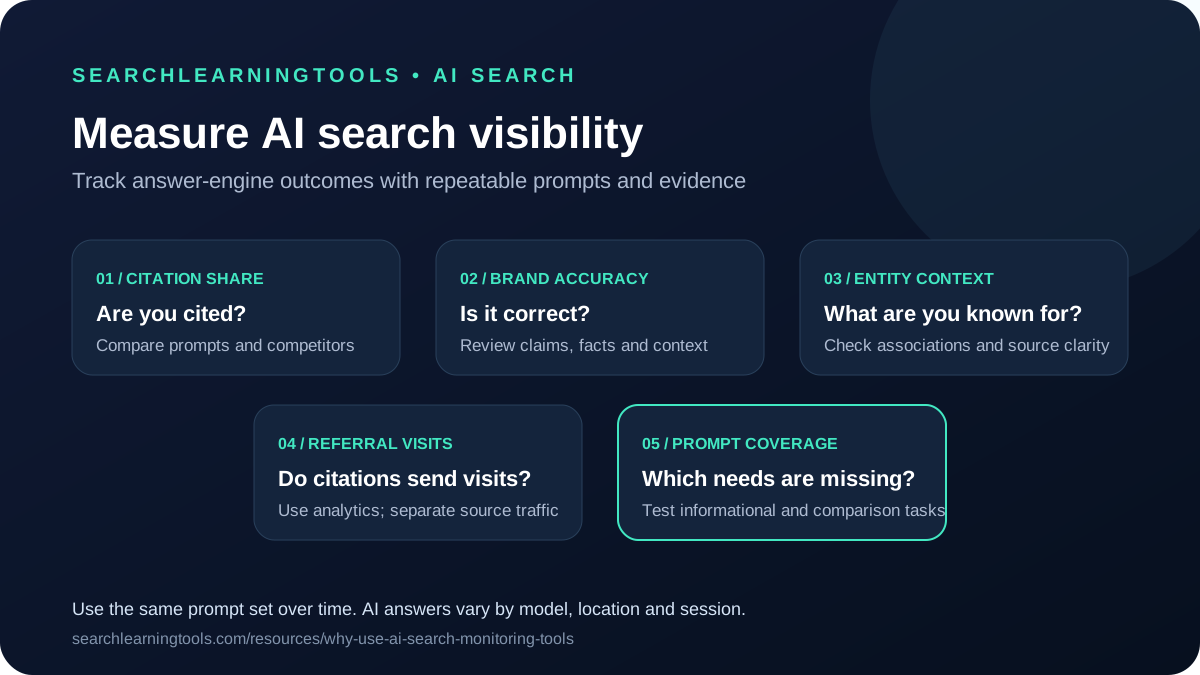
To systematically measure organic AI performance, growth teams track these 5 key indicators:
1. AI Citation Share (Share of Voice in LLM Answers)
What percentage of generated responses for your industry's core prompt clusters cite your domain as an authoritative source? Tracking citation share against direct competitors highlights topical authority gaps.
2. Brand Sentiment & Factual Accuracy
Are LLM outputs describing your product pricing, capabilities, and reviews accurately? AI brand tracking alerts you when models hallucinate discontinued features or incorrect pricing.
3. Knowledge Graph Entity Association
How strongly is your domain associated with target semantic concepts? Schema.org markup (such as Organization, SoftwareApplication, and FAQPage) anchors entity relationships directly in crawler databases.
4. Referral Traffic from AI Answer Engines
Measure organic session volume originating from chatgpt.com, perplexity.ai, and Google AI Overviews referral parameters in Google Analytics 4.
5. Prompt Cluster Dominance
Track visibility across Informational prompts ("how to calculate markup"), Comparison prompts ("Ahrefs vs free SEO tools"), and Transactional prompts ("best local plumber in Denver").
How to Optimize Your Pages for AI Answer Engine Citations
- Implement Direct-Answer Formatting: Place a clear, concise definition or answer within the first 100 words of each topical section.
- Use Question-Led Headings: Shape your H2 and H3 subheadings as natural-language user queries (e.g., "What is the formula for percent increase?").
- Deploy Valid JSON-LD Schema: Use our FAQ Schema Generator and Application LD JSON Generator to feed structured entity data to LLM scrapers.
- Grant AI Crawler Access in Robots.txt: Ensure your Robots.txt permits
GPTBot,OAI-SearchBot, andPerplexityBotwithout blocking script bundles.
Related Free Tools
SEO & AI Visibility Checker
Analyze your page for HTTP status, HTTPS, canonical tags, Google & AI crawler permissions, Schema.org JSON-LD syntax, and on-page SEO signals.
✓Checks HTTP status, redirects & canonicals
✓Audits 10+ Google & AI crawlers (ChatGPT, Perplexity, Claude)
+3 more benefits
AI Visibility Checker
Audit your web pages for direct-answer structure, question-based headings, schema coverage, and AI search engine permissions.
✓Direct-answer structure checks
✓Question-keyword alignment
+3 more benefits
Robots.txt AI-Crawler Tester
Evaluate published robots.txt access rules for Googlebot, Bingbot, OAI-SearchBot, PerplexityBot, GPTBot, and ClaudeBot.
✓Googlebot check
✓GPTBot check
+3 more benefits
Found this helpful? Share it:
Share on TwitterTurn the lesson into a workflow
The free guide explains the reasoning. The one-time AI SEO Prompt System packages repeatable prompts for the next research, briefing, and optimization pass.
See the AI SEO Prompt SystemQuestions About SEO Tools?
Yes, the core SEO tools are free. The optional AI SEO Prompt System adds structured workflows for a one-time $7.99.
Community Q&A
Questions and answers for this guide
Maya
9/12/2026
The keyword clustering prompts are clear, and the workflow helps me explain the why behind each content brief.
Leo
9/14/2026
I used the AI visibility checklist before publishing a guide and it caught a few gaps around direct-answer structure and heading clarity.